

The Early Years: From Tunis to Paris, the Fire of a Rebel Genius
A boy from Tunis, born on a 26 February (the year is uncertain: 1935 according to some sources, 1939-1940 according to others), with the Mediterranean in his eyes and a dream bigger than the desert dunes. Azzedine Alaïa was not just a couturier: he was an alchemist who turned fabric into living sculpture, shaping the female body with a sculptor’s precision and a rebel’s daring. From the dust of a modest childhood to the glory of Paris, his story is an explosion of creativity that redefined luxury as timeless art.
Childhood in Tunisia: sculpture and Vogue issues taken from his sister
Raised in Tunis in a modest family, the son of a farmer and a stay-at-home mother, Azzedine soon developed a unique sensitivity to aesthetics. His older sister Hafida was his first muse: he took her copies of Vogue to leaf through images of clothes that seemed like distant dreams. But it was not only fashion that captivated him: in Tunis, the white city overlooking the Mediterranean, he fell in love with sculpture, fascinated by the forms of the human body displayed in local museums. His grandmother, a cook for wealthy families, introduced him to the well-to-do ladies of Tunis, who commissioned small sewing jobs from him. It was here that he learned to handle needle and thread, developing an innate feel for draping and silhouette.


Studies at the École des Beaux-Arts and an apprenticeship with a midwife
At 15, Azzedine enrolled at the École des Beaux-Arts in Tunis, where he studied sculpture. This training shaped his approach to fashion: he did not draw clothes, he sculpted them directly on the body, with a precision reminiscent of an artist working marble. At the same time he worked as an apprentice to a local midwife, an unusual experience that taught him the anatomy of the female body in an intimate, practical way. This knowledge became the foundation of his style, which celebrates natural curves without constraining them, in sharp contrast with the rigidity of the fashion of the time. The midwife also taught him to work quickly and precisely, qualities that would make him famous for his “freehand” creations.


Arriving in Paris in 1957: early work with Dior, Guy Laroche and Thierry Mugler
In 1957, barely in his twenties, Alaïa moved to Paris, the capital of fashion, with a few francs in his pocket and an immense dream. He said he slept on a bench the first night, but his tenacity soon earned him an apprenticeship at Christian Dior. His stay, however, lasted only five days: the house let him go, probably because he lacked the necessary papers. He did not give up. He found work at Guy Laroche, where he stayed two seasons honing his technique; in later years he befriended and worked with Thierry Mugler, whose theatrical approach influenced him. During this period Alaïa began sewing made-to-measure clothes for private clients, often aristocrats, who discovered him by word of mouth. It was in these years that he laid the foundations of his atelier, turning his small flat into a workshop of unique creations.

Founding the House: Rebelling Against the Fashion System
Azzedine Alaïa was not just a couturier: he was a rebel who challenged the rules of the fashion system with an uncompromising vision. In the 1970s and 1980s, while the fashion world raced towards mass production and spectacular shows, Alaïa chose another path, that of craftsmanship and intimacy. The founding of his house was not just the start of a brand but a declaration of independence that redefined luxury as timeless art.
The Rue de Bellechasse atelier: private couture for the Parisian elite
In the 1960s and 1970s, working as a tailor for private clients, Azzedine Alaïa settled on Rue de Bellechasse, in the heart of Paris. This small space became a sanctuary for the Parisian elite: actresses, aristocrats and intellectuals — over the years his clients included Greta Garbo and Marie-Hélène de Rothschild — turned to him for made-to-measure clothes that enhanced the body without constraint. Alaïa worked almost exclusively by hand, draping fabric directly on his clients’ bodies, a practice that recalls the old masters of couture such as Madeleine Vionnet. His atelier was more than a workshop: it was a home, where he invited clients to dinner, creating a personal bond that made every garment a unique experience. This intimate, artisanal approach clashed with the frantic pace of fashion at the time, but it attracted a loyal clientele, won over by his dedication to perfection.

The American debut (1982): Bergdorf Goodman
Although Alaïa was already a familiar name among the Parisian elite, after his first ready-to-wear collections shown in Paris in 1980 and 1981, in 1982 his work arrived in New York, at the Bergdorf Goodman department store. The choice of New York was no accident: the city, with its dynamism and openness to the new, was the perfect stage for his daring aesthetic. The collection was a revelation: stretch leather dresses and body-hugging knitwear that embraced the body like a second skin, laser cuts and silhouettes that celebrated female sensuality without ever tipping into vulgarity.


The collection, with its famous perforated leather gloves and bodycon dresses, became a phenomenon, worn by icons such as Tina Turner and Grace Jones. Bergdorf Goodman sold the entire line within a few weeks, crowning Alaïa the “king of bodycon” and attracting the attention of the international press.
Officially founding the Alaïa brand (1983): independence and rejection of Fashion Week
Buoyed by his New York success, in 1983 Azzedine Alaïa officially founded the house that bears his name, maintaining iron-clad financial and creative independence. Unlike his contemporaries, he rejected the Fashion Week system, with its relentless pace and commercial logic. Alaïa chose to present his collections only when he was satisfied with the result, often at small private events in his atelier, away from the spotlight. This non-conformist approach made him a unique figure: while the big brands bowed to seasonal deadlines, he put quality first, working with a small team of artisans. The Alaïa house became synonymous with exclusivity and authenticity, attracting clients in search of timeless pieces, immune to passing trends. Rejecting the fashion system did not limit his success; it amplified it, turning him into a living legend.

The Creative Language: Fabric Sculptures and a Celebration of the Body
Azzedine Alaïa did not make clothes, he sculpted them. With an approach that fused craftsmanship and innovation, he turned fabrics into works of art that celebrated the female body, making it powerful, sensual and free. His creative language, unique and timeless, redefined fashion as living sculpture, able to converse with movement and the human form.
Revolutionary techniques: hand draping, laser cutting and perforations for a “second skin”
Alaïa’s work stands out for its obsession with silhouette and technical innovation. His hand draping, learned during his years in Tunis and perfected in Paris, was an art: he shaped fabrics directly on the body, without preliminary sketches, creating clothes that felt like a “second skin”.
His mastery was combined with avant-garde techniques such as laser cutting, which he introduced in the 1980s to create geometric patterns and precise perforations, giving fabrics a sculptural lightness. His perforated leather dresses and stretch-knit bodycon pieces, which hugged curves perfectly without constraining them, are famous. These innovations, such as body-shaping stretch fabric, revolutionised ready-to-wear, turning it into a form of couture that was accessible yet impeccable.I don’t draw on paper; my sheet is the body.
— Azzedine Alaïa, Vogue (1988)


Historical influences: homages to Vionnet, Balenciaga and Grès in his private collection
Alaïa was a passionate collector, the guardian of more than 25,000 fashion pieces ranging from Adrian to Comme des Garçons. His private collection, kept with obsessive care, was a constant source of inspiration, particularly the work of Madeleine Vionnet, Cristóbal Balenciaga and Madame Grès. From Vionnet, Alaïa took the art of fluid draping, adapting it to modern, close-fitting silhouettes. In Balenciaga he admired the rigorous architecture reflected in his structured yet sensual volumes. From Grès he borrowed a minimalist elegance, visible in his column dresses that flattered the figure without superfluous decoration. His creations, such as the mermaid dresses of the 1990s, are living homages to these predecessors, reinterpreted with a contemporary sensibility that amplifies their legacy.


A passion for art: collaborations with sculptors, photographers and designers such as Andrée Putman
Alaïa’s fashion was not confined to the wardrobe: it was a dialogue with art. A lover of sculpture, he worked with artists such as César Baldaccini, whose compressions inspired his structured silhouettes. His friendships with photographers such as Jean-Paul Goude and Peter Lindbergh produced iconic images, such as the 1980s campaigns with Naomi Campbell, which highlighted the dynamism of his clothes. Crucial was his collaboration with the interior designer Andrée Putman, who designed the minimalist yet warm interiors of his atelier and the Alaïa boutiques. His passion for art was also reflected in the Galerie Azzedine Alaïa, opened in 2004, where he exhibited works by contemporary artists alongside his own pieces, building a bridge between fashion, design and visual culture.


Iconic Collections: Moments That Changed Fashion History
Azzedine Alaïa did not follow the fashion seasons; he created timeless moments. His collections were not just clothes but manifestos of sensuality, power and innovation that redefined the language of luxury. Every show, every garment, was an act of rebellion against the fleetingness of the fashion system, establishing Alaïa as the couturier who sculpted time.
Spring/Summer 1983: the grommet leather gloves
After his success in New York, Alaïa presented his spring 1983 collection in his atelier on Rue de Bellechasse. It was an intimate event, far from the Fashion Week spotlight, but its impact was explosive. The collection introduced the famous grommet leather gloves, perforated with metal eyelets, which became a symbol of daring and sensuality. Stretch knit and leather dresses clung to the body like a second skin, enhancing curves without constraint. The press hailed him as the “king of cling”, and the collection marked the beginning of his legend in Europe, catching the eye of icons such as Tina Turner and Madonna, who wore his pieces on stage.
The 1985 Oscars de la Mode and Grace Jones carrying him in triumph
In 1985 Alaïa received two Oscars de la Mode (best designer and best collection), the prestigious French awards celebrating excellence in fashion, cementing his status as a master. The Autumn/Winter 1984 collection was a triumph of sculptural silhouettes: black leather dresses with bold zips, tube skirts and knitwear that looked carved. Grace Jones, his muse and close friend, became the face of the collection, wearing a figure-hugging hooded dress that embodied her magnetic energy. At a Paris event Jones literally carried him aloft in triumph, an iconic image that made covers around the world. The collection marked Alaïa’s entry into pop culture, with pieces that combined couture and punk attitude.


Spring/Summer 1991: the Tati Collection, a bridge between haute couture and streetwear
The 1991 Tati Collection is one of Alaïa’s most daring creations, a tribute to the Paris discount department store Tati, known for its cheap pink-and-white gingham fabric. Alaïa turned this humble material into high fashion: mermaid skirts, structured jackets and body-hugging dresses that mixed Parisian elegance with pop irony. The collection bridged haute couture and streetwear, anticipating the trend for accessible collaborations and proving that genius can elevate even the simplest of fabrics. The Tati Collection became a cultural phenomenon, worn by models such as Naomi Campbell and celebrated for its ability to democratise luxury without sacrificing quality.


The 1990s and 2000s: the bodycon dress, the corset belt and the stretch bodysuit for the supermodels
The 1990s and 2000s established Alaïa as the master of the bodycon dress, close-fitting clothes that sculpt the body like living statues. His creations, such as the leather corset belt and knitted stretch bodysuits, became the supermodels’ wardrobe: Naomi Campbell, Linda Evangelista and Stephanie Seymour wore them on and off the runway. The Spring/Summer 1992 collection, with its mesh dresses and laser cuts, was a hymn to modern sensuality, while Autumn/Winter 2003 introduced sculptural volumes with pleated skirts and architectural jackets. These pieces, often made without visible seams, embody Alaïa’s technical perfection and his love for the female body.
The last show (2017): a couture legacy and costumes for “The Marriage of Figaro”
In July 2017, a few months before his death, Alaïa presented his last couture show in Paris, his first in six years. It was an intimate event, as always, but charged with emotion. The collection, inspired by the purity of classical lines, included dresses that fused his signature draping with dramatic volumes, such as corolla skirts and leather bustiers. At the same time, Alaïa created the costumes for the opera The Marriage of Figaro at the Salzburg Festival, with clothes evoking the eighteenth century but revisited with modern cuts and innovative materials. This show is a testament to his vision: a union of art, theatre and couture that leaves an indelible legacy.


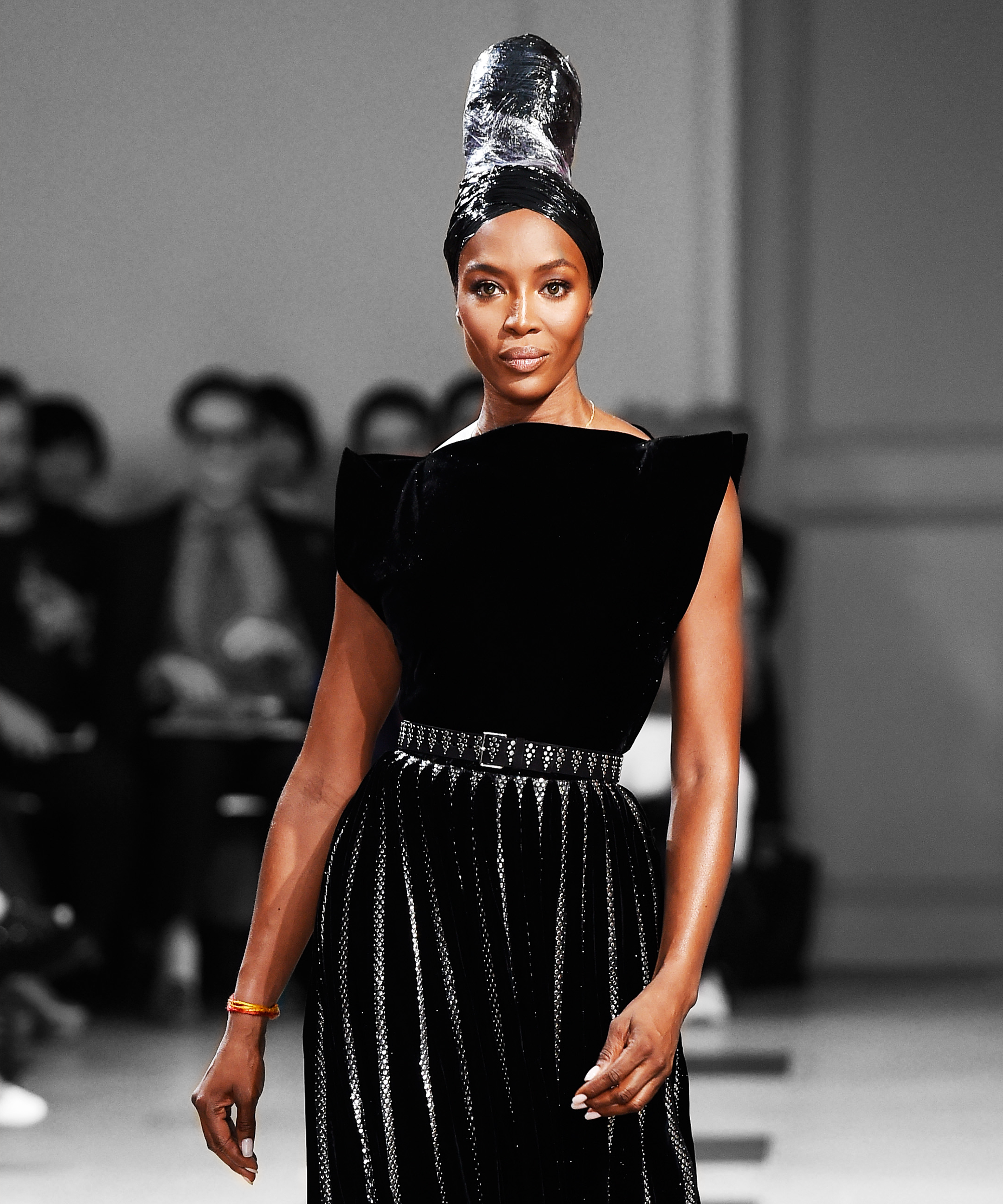
Azzedine and His Muses: Relationships That Defined an Era
Azzedine Alaïa did not just dress women; he forged deep bonds with them, turning them into muses who embodied his vision of power and sensuality. His relationships with film icons, supermodels and pop stars were not mere collaborations but creative alliances that left their mark on contemporary culture. Every dress was a love story between the couturier and the women who brought his creations to life.
Film icons: from Greta Garbo to Tina Turner and Madonna
Alaïa had a gift for attracting the greatest stars, women who embodied strength and charisma. In the 1970s Greta Garbo, a screen legend, frequented his Paris atelier, drawn by Alaïa’s discretion and mastery. In the 1980s Tina Turner wore his bodycon dresses and leather jackets on stage, turning the wild energy of her performances into a manifesto of female power. Madonna, the pop icon, often wore Alaïa in the late 1980s and 1990s, in stretch dresses and corsets that enhanced her silhouette. These pieces, often in black or with perforated details, were not just clothes but extensions of the personalities of the stars who wore them.


The supermodels: Naomi Campbell as a spiritual daughter, Linda Evangelista and Grace Jones
The supermodels of the 1980s and 1990s were more than clients to Alaïa: they were his family. Naomi Campbell, discovered at 16, regarded him as a mentor and adoptive father. She wore his close-fitting, sculptural dresses on the runway and in life, such as the famous bodycon dress from the Spring/Summer 1991 collection. Linda Evangelista, a versatile muse, wore his architectural looks with a grace that turned every show into an event. Grace Jones, close friend and androgynous icon, was the perfect face for Alaïa’s daring pieces, such as the hooded dress of Autumn/Winter 1984. These women were not just models but co-creators who brought Alaïa’s vision to life, making his clothes symbols of empowerment.


Pop collaborations: dresses for Clueless, A View to a Kill and Stephanie Seymour’s wedding
Alaïa’s influence reached beyond the runway into film and pop culture. In 1995 the film Clueless immortalised his red bodycon dress, worn by Alicia Silverstone, which became an icon of 1990s fashion. “This is an Alaïa, it’s like a totally important designer!” exclaims Cher, cementing its cultural status. In 1985 Alaïa designed costumes for Grace Jones in A View to a Kill, with leather dresses and bold silhouettes that embodied her Bond-girl charisma. In 1995 he created Stephanie Seymour’s wedding dress for her marriage to Peter Brant, a masterpiece of lace and silk combining sensuality and romance. These collaborations show Alaïa’s ability to translate his aesthetic into visual narratives that defined an era.
Alaïa Beyond Fashion: Collector, Gallerist and Ambassador of Beauty
Azzedine Alaïa was not just a couturier but a guardian of beauty in all its forms. His passion extended beyond fashion to embrace art, design and culture, with an obsession for preserving and sharing beauty. A tireless collector, visionary gallerist and innovator who made luxury accessible, Alaïa left a mark that transcends the wardrobe, turning it into a universal dialogue.
The private collection: more than 25,000 pieces of fashion history from Adrian to Comme des Garçons
Azzedine Alaïa was a fashion archivist, with a private collection of more than 25,000 garments gathered with obsessive care over his lifetime. Kept in his Paris atelier, these pieces ranged from Adrian’s Hollywood costumes to Cristóbal Balenciaga’s sculptural dresses and the avant-garde creations of Comme des Garçons. Every piece was catalogued and restored, treated as a work of art. His collection also included pieces by Madeleine Vionnet, Madame Grès and Charles James, which he studied for inspiration and as a tribute to the masters of the past.
The Galerie Azzedine Alaïa (2004): a space for art, design and photography
In 2004 Alaïa opened the Galerie Azzedine Alaïa on Rue de la Verrerie in Paris, a multifunctional space reflecting his love of art and design. More than a gallery, it was a meeting place for creatives, where he exhibited works by sculptors such as César Baldaccini, photographers such as Peter Lindbergh and designers such as Andrée Putman. The gallery hosted exhibitions that put his clothes in dialogue with contemporary art. The space embodied Alaïa’s vision of interdisciplinary luxury, where fashion, photography and design intertwined to inspire new generations of creatives.


Accessible partnerships: collaborations with 3 Suisses and Tati to democratise luxury
Despite his aura of exclusivity, Alaïa believed beauty should be accessible. In the 1980s he worked with the mail-order fashion catalogue 3 Suisses, creating a line of clothes and accessories that brought his aesthetic to a wider audience. His most famous collaboration is the 1991 Tati Collection, inspired by the Paris department store Tati and its iconic pink-and-white gingham. By turning a cheap material into high fashion, such as mermaid skirts and structured jackets, Alaïa proved that elegance could spring from any source. These partnerships not only democratised his style but anticipated the trend for collaborations between high fashion and mass-market brands, shaping the future of luxury.
After Alaïa: Continuity and Renewal
Azzedine Alaïa’s death did not interrupt the creative flow of his house: on the contrary, it opened a chapter of transition that honours his legacy while looking to the future. Through living archives, strategic partnerships and innovative leadership, the brand has found a balance between reverence for the past and momentum towards new forms of expression.
Azzedine’s death (2017) and the posthumous collections from the archives
On 18 November 2017 Azzedine Alaïa died in Paris, aged 77 or 82 depending on which year of birth is taken. Early reports spoke of a heart attack; other sources refer to an accidental fall on the stairs. The news shook the fashion world, where Alaïa was seen as an unrepeatable visionary, a “king of cling” who sculpted the female body with unrivalled mastery. His funeral, held in Sidi Bou Said near Tunis, was attended by muses such as Naomi Campbell, who regarded him as a spiritual father. Despite the grief, the house did not stop: the team carried on working, presenting posthumous collections based on the archives, a treasure of more than 25,000 pieces including prototypes, sketches and ideas never realised. The first, the 2018 “Intemporels”, paid tribute to his classics, such as the bodycon dresses and perforated gloves, sold to buyers in March. These releases, curated with rigour, preserved Alaïa’s artisanal essence, avoiding mere repetition and allowing the brand to breathe while a new creative director was sought.
The alliance with Richemont (2007) and the Fondation Azzedine Alaïa
In 2007 Alaïa sealed a crucial alliance with Richemont, the Swiss luxury giant (owner of Cartier and Van Cleef & Arpels), which acquired a majority stake to support expansion without interfering with creativity. The agreement, which included the production of footwear and leather goods, provided financial and distribution resources, allowing the brand to grow from an intimate atelier into a global presence. In the same year, with his partner Christoph von Weyhe and his friend Carla Sozzani, he founded the Association Azzedine Alaïa, which became the Fondation Azzedine Alaïa in 2020, a public-interest body at 18 Rue de la Verrerie in Paris. The foundation looks after the archive — his own creations plus more than 25,000 historic pieces from Balenciaga to Comme des Garçons — and promotes exhibitions, scholarships and educational programmes with institutions such as Parsons Paris. “It is a bridge between past and future,” says Olivier Saillard, its director.


Pieter Mulier as creative director (2021): a Belgian dream for an innovative future
February 2021: Pieter Mulier, Raf Simons’s long-time right-hand man from Jil Sander to Dior and Calvin Klein, was appointed creative director of Alaïa. “An absolute dream,” Mulier called it, a Belgian trained as an architect with an eye for structure and innovation. He began with Spring/Summer 2022, revisiting the archive with modern touches: sculptural silhouettes, high-tech knitwear and a focus on accessories such as the iconic bags. Under his leadership Alaïa expanded with new boutiques, while remaining independent of the Fashion Week calendar. His approach balanced loyalty to Alaïa’s DNA with contemporary empowerment, attracting younger generations and celebrities such as Rihanna, who wore his pieces at iconic moments. With Richemont at his side, Mulier steered the brand towards a future of ethical growth, where technical innovation meets timeless beauty. In 2026 Mulier left Alaïa to become creative director of Versace.
The Legacy: Exhibitions, Influence and the Future of the Brand
Azzedine Alaïa’s legacy is a living mosaic of exhibitions that tell the story of his genius, a cultural impact that permeates contemporary fashion and a brand that, in new hands, embraces sustainability and its sculptural roots. Not an epilogue, but an eternal rebirth.
Iconic exhibitions: “Azzedine Alaïa: The Couturier” at the Design Museum
In 2018 the Design Museum in London hosted “Azzedine Alaïa: The Couturier”, the first UK exhibition devoted to the master, conceived with him before his death. Curated by Mark Wilson, it displayed more than 60 pieces from the 1980s to 2017: bandage dresses, corsets and perforated leather celebrating the body as sculpture. The exhibition, organised with the Foundation, included atelier videos and original patterns. A tribute that turns fashion into female empowerment and cultural dialogue.
Cultural impact: from MoMA to the Palais Galliera, a living archive for contemporary fashion
Alaïa’s archive, with its 25,000 pieces, is a beacon for fashion: it influences contemporary designers with its emphasis on form and the body. At the Palais Galliera, “Azzedine Alaïa: Couturier Collectionneur” (2023-2024) revealed 140 pieces from his private collection — from Vionnet to Gaultier — showing his passion for history. “A backup of the twentieth century,” Olivier Saillard calls it. The Foundation’s exhibitions often set Alaïa in dialogue with past masters, promoting education and scholarships. The impact is global: from film (Clueless) to pop culture, Alaïa inspires sustainability and craftsmanship, with the Foundation organising talks and restoration work for an accessible legacy.
Alaïa today: after Mulier
Under Pieter Mulier (2021-2026) Alaïa returned to centre stage: new boutiques, strong growth in accessories and event shows outside the usual calendars, including one at the Guggenheim in New York. Mulier presented his last collection for the house in March 2026 and moved to Versace, where he has been creative director since 1 July 2026. As of mid-October 2026 Richemont has not yet named his successor.
Notes
- The New York Times. (2013). “Azzedine Alaïa: The Greatest Couture Who Never Bore the Name.” Retrieved from https://www.nytimes.com/2013/09/25/fashion/azzedine-alaia-the-greatest-couture-who-never-bore-the-name.html
- Fondation Azzedine Alaïa. (n.d.). “Une Autre Pensée sur la Mode: La Collection Tati.” Retrieved from https://fondationazzedinealaia.org/en/shop/une-autre-pensee-sur-la-mode-la-collection-tati/
- Fondation Azzedine Alaïa. (n.d.). “Chronologie.” Retrieved from https://fondationazzedinealaia.org/en/chronologie/
- Fashion United. (2017). “Timeline: The Life & Career of Azzedine Alaïa.” Retrieved from https://fashionunited.uk/news/people/timeline-the-life-career-of-azzedine-alaia/2017112026885
- Business of Fashion. (n.d.). “Azzedine Alaïa Profile.” Retrieved from https://www.businessoffashion.com/people/azzedine-alaia/
- Vogue. (1991). “Spring 1991 Ready-to-Wear: Azzedine Alaïa.” Retrieved from https://www.vogue.com/fashion-shows/spring-1991-ready-to-wear/azzedine-alaia
- The New York Times. (2021). “Pieter Mulier at Alaïa.” Retrieved from https://www.nytimes.com/2021/02/05/style/azzedine-alaia-pieter-mulier.html
- Richemont. (n.d.). “Alaïa Overview.” Retrieved from https://www.richemont.com/our-maisons/alaia/
- Palais Galliera. (2023). “Azzedine Alaïa: Couturier Collectionneur.” Retrieved from https://www.parismusees.paris.fr/en/exposition/azzedine-alaia
- Wikipedia. (n.d.). “Azzedine Alaïa.” Retrieved from https://en.wikipedia.org/wiki/Azzedine_Alaïa
Azzedine Alaïa was born in Tunis on 26 February; the year is uncertain: 1935 according to some sources, 1939-1940 according to others.
Azzedine Alaïa died in Paris on 18 November 2017, aged 77 or 82 depending on his year of birth. Early reports spoke of a heart attack; other sources refer to an accidental fall on the stairs.
Since 2007 Alaïa has been linked to Richemont, the Swiss luxury group that also owns Cartier and Van Cleef & Arpels, which supports its expansion without interfering with creativity.
Pieter Mulier, long Raf Simons’s right-hand man from Jil Sander to Dior and Calvin Klein, was appointed creative director of the house in February 2021. He left Alaïa in 2026 to lead Versace.
This content contains affiliate links: if you buy through these links we may earn a commission, at no extra cost to you.
Read Wordrobe’s editorial method: sources, fact-checking and corrections.